© Daniel Vogl
Music and Health
Investing in Culture is Investing in Health
Various studies have shown that actively making music and experiencing music have positive effects on physical and mental health—whether as a preventive measure or in the form of music therapy as part of acute treatment, whether during early childhood development, for adolescents, adults, or in old age and during illness. At the same time, music enables people with mental or physical illnesses and their families to be included in society and to participate in social and cultural life, and in this way can also help reduce loneliness. This is particularly evident in the case of people living with dementia.
Latest News
Online-Symposia „Mittwochs um 5“
The next sessions of these free events will take place on
September 30, 2026, 5:00–6:15 p.m. ꟾ Focus: Training in Music and Dementia
November 26, 2026, 5:00–6:15 p.m. ꟾ Topic tba.
Networking Forum to Music and Dementia on November 20 2026 in Leipzig
We are committed to:
an interagency national strategy for „Culture and Health“ in collaboration with civil society stakeholders, similar to, for example, the „Netzwerk Nationale Demenzstrategie“ or the „Einsamkeitsstrategie“
the development of the structures needed throughout Germany to provide needs-based music-based programs for people with dementia and their families
the implementation of „social prescribing“ („Kultur auf Rezept“) projects based on concepts that have already been tested internationally, in order to enable people with mental and physical illnesses to participate in cultural and social life
greater integration of scientific research on the development, impact, and cost-effectiveness of music and cultural programs, as well as music therapy, into the public health care system
the recognition by health insurance companies of health-promoting cultural prevention measures, similar to yoga or exercise classes
patient safety in the healthcare system and quality assurance in the therapeutic professions, including through legal regulations governing music therapy and the arts-based therapies
Further Informations
In this 20-page publication, you can learn more about why music is key to improving quality of life for people with dementia, as well as about the goals, advocacy efforts, and networking activities of the Federal Initiative on Music & Dementia. The German Music Council is one of the initiative’s supporting organizations.
The resolution drafted during the 2024 Music and Health symposium and adopted by the General Assembly of the German Music Council emphasizes that actively making music and participating in musical activities have been shown to promote physical, mental, and social health. It therefore calls for music to be more firmly established in policy and society as a health resource—for example, through preventive programs, music therapy, research, and health-oriented training for musicians and educators.
Symposium „Music and Health“ (2024)
© DMR/ Dominique Krentscher
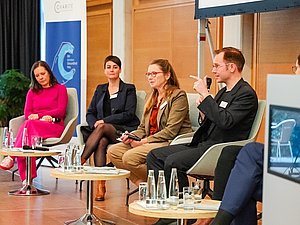
In cooperation with Charité Universitätsmedizin Berlin, the German Music Council hosted the symposium „Music and Health“ in Berlin on October 18, 2024. Through keynote presentations, practical examples, panel discussions, and debates, the event focused on health promotion through music, music therapy, music physiology, and musicians’ health.
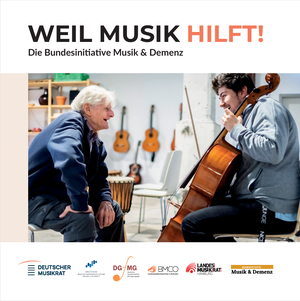
Music and Dementia
About 1.8 million people are currently living with dementia—and the number is rising. As a founding member of the Federal Initiative on Music & Dementia (BIMuD), the German Music Council, together with the German Music Therapy Association, the German Society for Music Geragogy, the Federal Music Association for Choirs & Orchestras, and the Hamburg State Music Council, is committed to enabling people with dementia and their families to participate more fully in cultural and social life.
The goal is to make much greater use of music’s diverse potential in the context of participation, treatment, care, and support for people with dementia than has been the case to date. The need is great, but current offerings fall far short of meeting it. Musical and artistic programs, music-based geragogical and educational activities, and music therapy—both in senior care facilities and in home settings—must be significantly expanded and made more accessible.
Contact for the Topic Music and Dementia
Dr. Anna Vogt
Speaker
E-Mail: generalsekretariat@musikrat.de